Saturday, February 5, 2022

Volunteers Make Things Happen


Last fall, a small group of volunteers from Iowa Master Naturalists spent time on the Greenway cutting woody brush to help keep these aggressive shrubs and saplings from taking over and crowding out the less-assertive native prairie plants that are planted in the cells along the trail. 

Volunteers also joined in with the South District Neighborhood Association's Team Up to Clean Up event last April, picking up trash that blows into the area or flows in with heavy rainfall from surrounding neighborhoods.  

There are so many ways to help your community, and often the only requirement is being willing to show up! The SDNA has a number of opportunities right here in the neighborhood, including helping with neighborhood leisure bike rides during warmer months. Similarly, you can volunteer with the Bike Library, headquartered just across Highway 6 from the South District. If you are an animal lover, the Iowa City Animal Center is just a short jaunt away.  Backyard Abundance does amazing work with their Edible Forest at Wetherby Park, with opportunities to get involved both at that location and elsewhere. Tune in to local organizations and watch for events and other opportunities to help make our community a great place to live.

You don't have to take part in formal volunteer programs either. If you notice litter around your patch, why not grab a bag and pick it up? If a streetlight is out, a couch has appeared in a nearby ditch, or even the potholes get to be too much, you can easily submit a report at ICgovXpress. 

If you'd like to be notified when volunteer opportunities at the Sycamore Greenway will be happening, you can sign up here. Brush cutting will resume with warmer weather, and trash pickup will be scheduled once or twice a year as needed. 


Saturday, January 8, 2022

Pondering Sparrow Distribution


Looking out into my backyard on the south side of town, I peer through binoculars to quickly count the dozens of sparrows that dropped down onto the snow to grab the scattered sunflower hearts, before a flitting shadow sent them all fluttering into a neighbor's tree. Before they went, I noted two Eurasian Tree Sparrows among all the House Sparrows, their round black cheek patch making them easy to pick out.

They are uncommon visitors to the yard, usually only stopping by when there are a few inches of snow on the ground. I often, however, spot a few of them along the wooded northern end of the Greenway trail (and occasionally south by the wetlands as well). I've also seen them near the McCollister bridge and vicinity, a little to the west. I wonder, how widespread are these little sparrows throughout the city?

House Sparrow
Eurasian Tree Sparrow
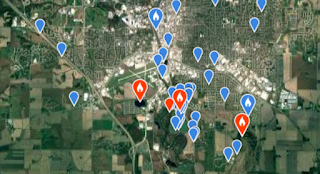
I turn to eBird, with its extensive data about bird observations, and compare the local maps for Eurasian Tree Sparrows with those of House Sparrows, showing (as expected) the House Sparrows are extremely common throughout town. Eurasian Tree Sparrows, though not rare, had more sporadic spottings, with a cluster around TTRA.  

Eurasian Tree Sparrows are a fairly recent settler in our area; most of the records on eBird are from the past ten years, with only two sightings recording between 2001 and 2011 (although I am unsure how comprehensive data submitted to eBird for that timeframe is, compared to more recent observations). Perhaps they are just getting started in Iowa City, as the species continues its slow expansion from St. Louis, where just a dozen or so birds were released in 1870. 

Will they continue their expansion through town, with more numbers appearing along the brushy margins near the river and other waterways, where they can find shelter and cavities for nesting away from their more urban, and more aggressive, cousins? Or have they already established themselves in those areas that are suitable, to remain in smaller numbers than the House Sparrows?

Either way, I feel fortunate to have these thus-far well-mannered sparrows as neighbors in the South District, and will watch their movements with interest.


Saturday, December 18, 2021

Meditation on a Feather


 A single wispy white feather, backlit by the morning sun, caught on a slender stem near the ground. A few crystals of frost glitter along the threadlike barbs. It's a fairly large feather, so I assume from a fairly large bird. Maybe it fluttered to the ground from one of the geese winging overhead?

My brain catalogs it as a down feather, the fluffy white feathers close to a bird's body, under the smooth outer feathers, that help insulate it from the cold outside. A bit of research with the Cornell Lab's Bird Academy introduces me to the seven different types of feathers: wing (or remiges), tail (rectrices), contour, semiplume, down, filoplume, and bristle. 

The first three--wing, tail, and contour feathers--are those we are most familiar with, the feathers we see immediately when looking at a bird. They are used for locomotion and protection from the elements, as well as communication (for example, courtship and territorial displays). They have a central shaft, or rachis, flanked by a series of barbs that are zipped together by interlocking barbules and tiny hooks called barbicels.

Down and semiplume feathers trap heat below the surface feathers; these feathers lack the hooked barbicels so they don't zip together as neatly as the surface feathers. Semiplume feathers have a central rachis, which is reduced or absent in a down feather--so my feather here appears to be a semiplume. 

The other two types of feathers are not easily visible: filoplumes, whiskery feathers with a tuft of barbs at the end, thought to help birds feel or sense what is going on feather-wise (since the feathers themselves don't have nerves in them), and bristles, basically just a threadlike rachis without barbs along most of its length, often found near a bird's eyes or beaks and also thought to provide additional sensory information.

Watching birds preen, carefully drawing a long feather through its bill to zip the barbs together cleanly, I marvel at the efficient and tidy bodily covering, so different from my own lackluster human coat, with its messy mop of hair that snarls and curls and tangles, above a pale and sensitive pink skin that requires a different protective coating for essentially every different condition: winter coats, rain coats, jackets, sweaters, sunscreens, hats.

How convenient it would be to have just a single covering for every condition and every season! When cold, puff up and allow those downy feathers to capture heat close to your body. Rain runs off the sleek, overlapping arrangement of feathers, while feathers shade the tender skin beneath from the sun's damaging rays. I imagine the meditative calm of arranging each feather so it lies perfectly in place, or maybe the irritating discomfort of a broken or misaligned feather. 

I wonder what the birds think, seeing us in our ever-changing array of adornments through the seasons, unable to face the elements without all these accoutrements, unable to compare to the marvel of a single feather. 


Sources/Additional Reading: