Saturday, May 29, 2021

Cultivating the Greenway

 Wow, those are some interesting new volunteers! I thought, seeing the colorful irises  at the edge of the trail. They came up fast!

I don't usually consider irises as likely candidates to spread out into the wild from their garden beds, but there is at least one other frilly-petaled transplant, this one tall and pale yellow, that had somehow found its way into the Greenway. Perhaps "volunteer" isn't the right word; rather I imagine "chucked into the Greenway with a load of yard waste" as unfortunately often happens. Further south, away from the human habitation, a small stand of a native, Blue Flag Iris (Iris versicolor) was at least in recent years ensconced in the low-lying center of one of the cells, where it is more likely to keep its roots wet.

Upon approaching closer, I saw that, no volunteers, these, the irises were planted in a neat row just at the margin of the mowed area alongside the trail, nestled amongst the grasses in a neat bed of potting soil. An enterprising neighbor, perhaps seeking to beautify the nearby greenspace with some extras from their yard? I was torn. 

The flowers are gorgeous, no doubt, and certainly placed there with a good intent to beautify what can seem like a ditch overrun with weedy grass, cattails, and various aggressive non-natives like Queen Anne's Lace and Sweet Clover. What is the harm? That other aforementioned "volunteer" iris has been thus far well-behaved, not spreading or crowding its neighbors. There's no reason to expect these little newcomers to behave differently. 

But the threat of introducing non-native species into an uncontrolled landscape looms. After all, there is ample precedent for pretty non-natives turned loose on the landscape and becoming thuggish invasives that crowd out the original inhabitants while offering little to no benefit to the pollinators, birds, and other wildlife that could previously rely on the native plants with which they evolved for millennia. Queen Anne's Lace, Garlic Mustard, Callery Pear, Crown Vetch...all began as pretty garden or useful landscape plants. 

Bearded irises don't seem to present the same threat, although there is a non-native Yellow Flag Iris, a beardless "wild iris" that has become quite invasive in neighboring states (it does not appear to be present in great numbers in Iowa yet). So perhaps the new floral neighbors will be well behaved....

Daisies in the grass
And yet. I wonder about the propriety of introducing plants into land one doesn't own. Certainly it would be a bad idea to plant garden cultivars in a prairie remnant or a nature preserve, disrupting the intent of these places as a carefully-tended memory of pre-settlement ecology and refuge for those native species that can't compete with the more assertive introduced plants and animals. 

But what about public, city-owned spaces like the Greenway trail and its flanking stormwater management cells, planted with native prairie plants but also host to a number of non-natives that are considered undesirable, including daisies that look like they escaped a quaint cottage garden, Reed Canary Grass, Wild Parsnip, Multiflora Rose, and the aforementioned Queen Anne's Lace and Sweet Clovers? To those walking the trail, it can sometimes look like a neglected ditch, with a few wildflowers but mostly weeds overtaking the open space. Other parks are carefully tended, with regular prairie burns, attempts to mitigate invasive species like garlic mustard. 
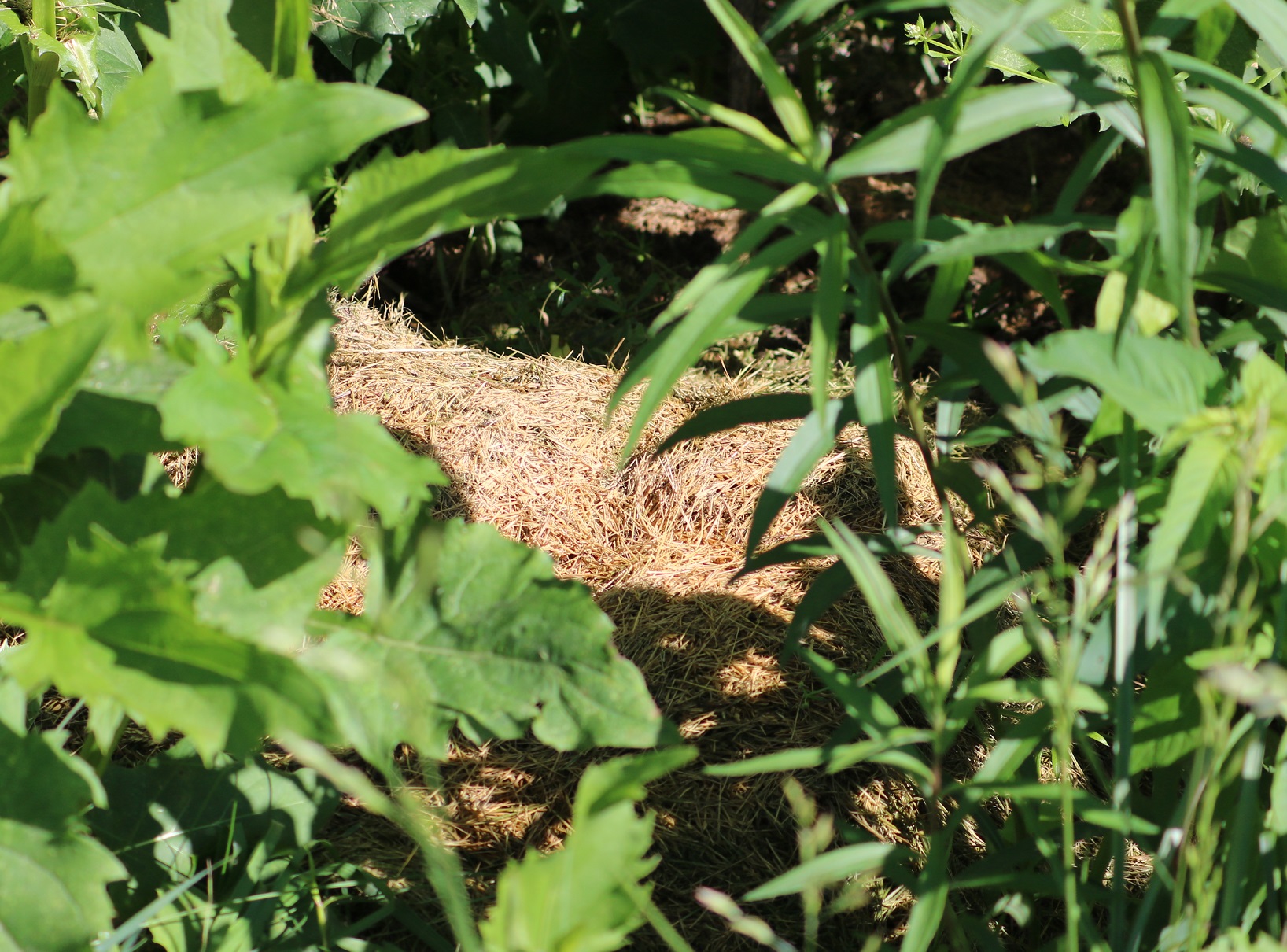
Grass clippings left
in the Greenway

The Greenway, on the other hand, has lately been left to fend for itself. It has been mistaken for a dumping ground, with pet owners lobbing their bagged waste into the cells, neighbors dumping such oddities as grills, bicycles, and on one occasion, a storage ottoman stuffed with assorted home items, as well as yard waste, unwanted potted plants and woody brush chopped and dragged from neighboring yards. Given this unfortunate appearance, isn't any attempt to beautify the space a laudable thing?

I've been tempted myself to plant some spare Liatris or other native plants I've grown in abundance from seed in the Greenway, to add a bit of diversity. Similarly, informal campaigns by "guerilla gardeners" have attempted to beautify and make use of bits of public or vacant land, and "seed bombs" are a common method of spreading milkweed seeds off the beaten path, wherever the bomb-lobber sees fit.

Are these efforts helpful or harmful? I don't know if I can say. 

Clearly I am overthinking these few pretty flowers that have colonized a tiny strip of the Greenway. It's what I do! But it's worth pondering the intent of the Greenway: managing stormwater, providing a place for neighborhood recreation along the trail, and hopefully a bit of habitat for local wildlife. A few well-behaved irises don't interfere with that. Would a few dozen? Would a plethora of neat domestic plants change the character of the wild-and-free Greenway? Does the current plethora of non-natives? 

Would the Greenway benefit from a bit more hands-on management, like some of the other more natural parks receive? Or is it a unique and enjoyable insight into what a new paradigm of nature looks like, with plants from all over the world coming together and duking it out until they reach a new equilibrium?

What do we want to see from our Greenway?

Saturday, May 15, 2021

A Frothy Hideaway

 Have you ever wanted to get away from it all, just submerge yourself in a cozy, secluded place where no one will bother you, with nothing to do but, say, eat and maintain the basic functions of life?

The spittlebug is way ahead of you.

You may have noticed their little isolation chambers, clusters of bubbles nestled under the leaves of plants in the spring. If your immediate thought was "gross" with no interest in investigating further...the spittlebug's goal is accomplished. 

But if you, undaunted, probed the bubbles in search of the cause, you might find the architect: a vaguely unformed froghopper nymph, plump and beady-eyed. Not being interested in eating said nymph, you allow it to retreat into its nest, to the comfort and safety of its climate-controlled predator repellent system. 

If you imagine a charming little bug blowing bubbles like a child with a bubble wand, or maybe hocking tiny loogies all day...think again. The spittlebug ingests copious amounts of sap from its host plant through its piercing and sucking mouthparts; after being digested the excess excreted...well, where digested materials are usually excreted. The spittlebug will arrange the bubbles around its body, with no need to show itself beyond the bubbles save to occasionally stick its rump out to breathe (like other insects, it breathes through spiracles, breathing tubes located along the thorax and abdomen).

The nymph will go through all its instars safe within its bubble nest, emerging in June as an adult froghopper. 


Watch the spittlebug in action in this amazing video from the New York Times:


Friday, April 30, 2021

Chimneys in the Grass

 Last week's cleanup, part of the South District Neighborhood Association's Team Up to Clean Up event, was a great success. More than a dozen neighborhood residents and allies came out on a gorgeous sunny morning to fill bags with trash that blew in or flowed into the planted cells lining the trail from the surrounding streets. 


As I was making a last pass along the bottom of the cell just north of the Birds in Flight sculpture, I spotted a much more modest sculpture on the ground. It looked like a rounded urn constructed from hard balls of mud or clay, maybe eight inches tall with a wide opening at the top. I poked it, felt its material was solid and dry, and then hurried off to deposit my bag of trash with the others. As I hurried, I passed a second little urn, also on the ground, also composed of what looked like little mud balls. 

Later in the day, I went searching for the origin of the curious urns. The sheer scale of the construction seemed to rule out any ground-nesting bees or other insects; each of those mud balls would be larger than most insects around these parts and unwieldy to impossible for them to maneuver. A little googling and image searching later, I stumbled across a photo that resembled my urn: it was a a crawfish chimney!

Ah, my sheltered life. I know crawfish (or crayfish, or crawdads). I've seen them once or twice scuttling across the flooded trail down at the Snail Crossing by the Sycamore Apartments. I've admired their sweet pincers and the elegant flared tail. I've marveled at their bright red corpses being gleefully devoured at cajun festivals, or being torn apart on cooking shows. But if I had ever noticed their chimneys before, I never knew the architect behind them.

The crawfish responsible for the chimneys burrow and live underground; the chimneys are the result of the crawfish's excavations, as they carry dirt or mud out of the burrow and place it at the surface opening. But aren't crawfish aquatic? What were these chimneys doing in the middle of the dry planted cells of the Greenway (which, to be fair, can be submerged for days at a time after a rain, but just as often are crisp and dry in the springtime sun)?

To being with...not all crawfish are entirely aquatic! These burrowers, the builders, can live some distance from creeks or other water bodies. They need water to breathe and survive, though, so they will burrow underground until they reach the water table--sometimes several feet. They can leave their burrows for scavenge for food: as detritivores, they will eat just about anything they come across, live or dead, fresh or decomposing. 

These crustaceans, rarely seen from the trail, play an important role in the ecosystem, not only as a clean-up crew for organic material but also as builders of burrows that can be repurposed by other species as a home or refuge: snakes, frogs, insects, and others may take advantage of the work done by crawfish, much the same way that woodpeckers excavate cavities in trees that can later be used by other birds and animals that cannot excavate their own nests. 

Who would imagine, as we cleaned up our human detritus, the unseen crawfish lurking deep in their burrows perform a similar function to keep the Greenway working smoothly?