Saturday, March 14, 2020

Surprise Packages

Friends. I normally like to spend time talking about and photographing all the amazing things to see and hear long the Greenway trail: cardinals and chickadees singing, coneflowers and compass plant blooming in the summer, bees and butterflies buzzing and fluttering.

It's a joy to walk along the trail on a bright spring day and see so many people from the area biking, walking, jogging. Many a dog is treated to its daily constitutional on the trail...and with them comes today's plea.

Please, please, pick up after your dog! Not only is it the responsible thing to do for your pet and your neighbors, it is the law.
City Code 8.4.6.H:
Solid Waste Removal: Any person who shall walk an animal on public or private property shall provide for the disposal of the solid waste material excreted by the animal by immediate removal of the waste, except for animals properly trained and certified to assist persons with disabilities while such animals are acting in such capacity.
I understand, I really do, that it is a hassle to bag your dog's poop and carry it with you. I understand, but don't condone, just leaving the pile in the grass alongside the trail, for some unwitting photographer to kneel in when trying to get a closer look at an interesting bug on a leaf. It happens, and nature will eventually take care of the problem.
 
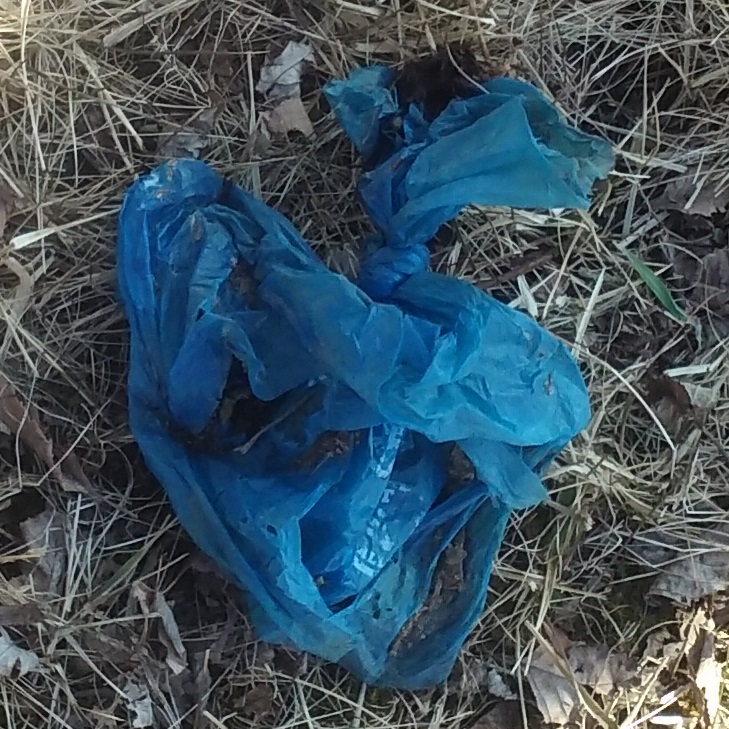
 What is utterly confounding, however, are the bagged piles that are knotted and tossed into the planted Greenway cells, there to remain in brightly-colored plastic glory, until some poor sap volunteering time to pick up trash has to fish them out and dispose of them properly. Some bags even end up dangling from tree branches near where woodpeckers and sparrows make their nests in the summer.

Are the bags marketed as degradable? If so...they are not. At least not within any reasonable timeframe. Where do you, baggy-hurlers, think the bundles will go after being tossed? Is it an effort to thoughtfully prevent the waste from being an unsightly mess alongside the trail, with the tradeoff being a longer-lasting unsightly mess a bit further from the trail? The thought is a kind one, though the effects are perhaps not as intended.

The simple fact is, the Greenway--like all our public parks and natural areas--is our shared home. We are all responsible for keeping it in order, and we all benefit when it is properly maintained and cared for. We wouldn't throw bagged waste in our backyard, or our neighbor's backyard, or on the sidewalk downtown. The Greenway deserves the same respect. Please be considerate with our shared spaces for everyone's enjoyment. It's the right thing to do!


Bonus(?) shot of an inexplicable pair
of socks hung in a shrub to dry.

Saturday, February 22, 2020

The Chickadee's Charming Cousin

What a treat seen frolicking around the wooded area east of the Birds in Flight sculpture...meet the Tufted Titmouse (Baeolophus bicolor), the chickadee's charming cousin!

These little ones are birds of the woodlands (and suburbs with mature trees), where they nest in cavities abandoned by woodpeckers. Eastern Iowa is near the far northwest edge of their range, which has steadily expanded over the past century due to a combination of an increase in favorable habitat, access to backyard feeders, and milder northern winters due to climate change. 
 
Wide-eyed and curious, titmice will join in mobbing predators and will brazenly pluck fur from dogs, humans, and other much-larger mammals to line their nests. Despite their bravery in some situations, titmice are easily shooed away from feeders by most other bird species, including the seemingly gentle dark-eyed junco. 

Listen for their high, clear peter peter peter song from the trees. They also have a chickadee-dee-dee warning call that sounds very much like that of chickadees, given when a predator is spotted. As with chickadees, the number of dee-dee-dees can vary depending on the type of predator. 

In the winter, titmice will form small flocks, usually a mated pair occasionally joined by their offspring or other young birds. They can be seen feeding in the same area as chickadees, nuthatches, and downy woodpeckers, and are common visitors to feeders, where they enjoy peanuts and, especially, sunflower seeds (which they will adorably hold in their feet and peck to open the shell, sometimes caching the seeds in bark for later).

If you live in a neighborhood with large trees, keep an eye (and ear) out for these charismatic little birds. You won't be disappointed!

Sources/more information:

Sunday, February 9, 2020

Doing things the right way for waterways

Iowa River, near the McCollister bridge
How many times have you looked out over the Iowa River on a hot, sunny day and thought about how nice it would be to go for a dip? Or encouraged your children to frolic in a shallow creek, or let your dog drink from a lake after a tiring hike?

If you're in Iowa, the answer is probably "not often." Certainly there are treacherous currents and natural hazards in the waters, but more likely the reservations are related to human-caused pollutants: chemicals from fertilizers and pesticides applied to lawns and crops that are washed into our waterways; manure from ag industry properties; trash and other waste making its way into our streams and rivers. Iowa's rich topsoil, our agricultural heritage, is lost via erosion at a rate of more than 5 tons per acre a year.

These pollutants can harm the health of humans and wildlife here in Iowa. Witness the numerous beach closings and warnings related to harmful pathogens every year, or periodic fish kills. And the effects aren't limited to the state that introduces the pollutants into the waterways: everything we do here in Iowa makes its way downstream, even all the way to the Gulf of Mexico, where nutrients from our fields help contribute to the "dead zone" the size of Massachusetts--an area inhospitable to fish and other ocean-going creatures.

Why do we tolerate this state of affairs? We wouldn't tolerate businesses dumping their waste in our backyards; why do we tolerate them dumping it in our shared waterways? There are proven strategies that can help reduce and mitigate the effect of runoff from fields, including the use of cover crops, buffers, and preserving wetland areas, as well as other practices that would minimize erosion and reduce the amount of harmful materials that find their way into our rivers and streams (the Sycamore Greenway itself is an example of land use designed to mitigate runoff into our waterways, as it diverts runoff from neighborhoods into cells lined with deep-rooted native plants). Many responsible farmers implement them and act as good stewards of their land. But many others do not, as these practices come with a cost that would reduce profits.

Paddlers on (not in!) the water
(Great Iowa River Race, 2017)
In December of 2019, the DNR released its work plan (PDF) for water quality standards. Unlike the plans of all of our neighboring states, it did not include a plan to adopt numeric nutrient criteria, which would establish specific standards for when a issues need to be addressed instead of the current subjective criteria being the presence of “aesthetically objectionable conditions” and “nuisance aquatic life.” Iowa can and must do better.

Legislators in Des Moines have made noises about finally taking steps to fund the Natural Resources and Outdoor Recreation Trust Fund, which was originally planned to fund a variety of conservation and recreation programs, including REAP and recreational trails. Industry groups, however, are working to adjust the allocation from what voters originally approved to a new formula that would emphasize water quality and nutrient reduction rather than conservation and recreation.

But why then are we expecting general taxpayers to clean up after polluting industries instead of those who profit by not implementing the (voluntary) nutrient reductions strategies that would be effective? Why, for example, should fields be planted all the way to the edge of streams instead of requiring buffer zones? Industry should not be able to maximize profits while externalizing the costs to clean up after themselves to taxpayers. They are our shared waterways, our resources.

Iowa needs to step up and establish basic standards for our waters, and regulate those whose business practices cause harm to our shared resources. The costs of doing business must be internalized; that is, included in the cost of the materials that are produced rather than offloaded to taxpayers to clean up. The brunt of the costs for keeping our waterways clean should fall on those who profit from making them dirty, and the allocation of funds for the Natural Resources and Outdoor Recreation Trust Fund should remain as originally approved by voters.


Sources and additional information: